
The Daily Brief: October 23, 2026
5 stories, bottom line up front. Every fact confirmed by at least two outlets.
- Justice Department sues to block possible certification of Alaska Senate result
- About 21 million Americans have already voted in the midterms
- Personalized mRNA cancer vaccine cuts melanoma recurrence in a late-stage trial
- AI-driven tech selloff hits Wall Street as oil prices rise
- Treasury proposes tighter limits on US tech investments in China and other countries of concern
Justice Department sues to block possible certification of Alaska Senate result
The Justice Department filed a federal lawsuit Thursday (Oct 22) to stop Alaska from certifying its U.S. Senate race if Republican Sen. Dan S. Sullivan loses to Democrat Mary Peltola. The suit says a second candidate on the ballot, Daniel J. Sullivan, could confuse voters, and asks for a pause on certification while officials investigate. An election law expert quoted by CNN called the legal theory "strange and unusual."
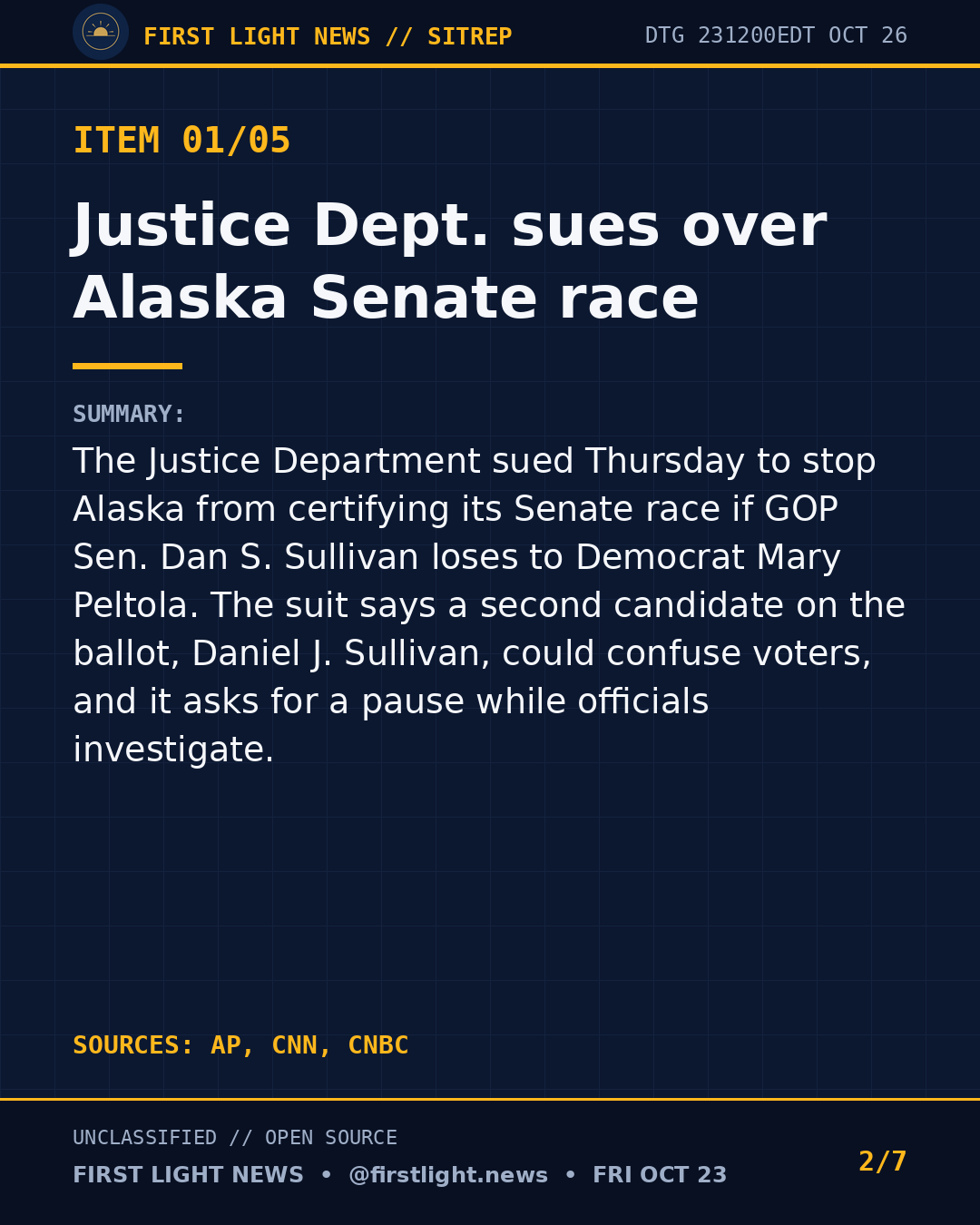
About 21 million Americans have already voted in the midterms
With Election Day on Nov. 3, about 21 million people have voted early by mail or in person, according to the University of Florida's Election Lab, as cited by NPR. NPR reported early turnout in battleground states is well above the last midterm, but cautioned that early numbers don't predict final results.
Sources
Sourcing note: NBC's confirmation comes from a video transcript and gives a rounded figure. The exact "about 21 million" number is from NPR.
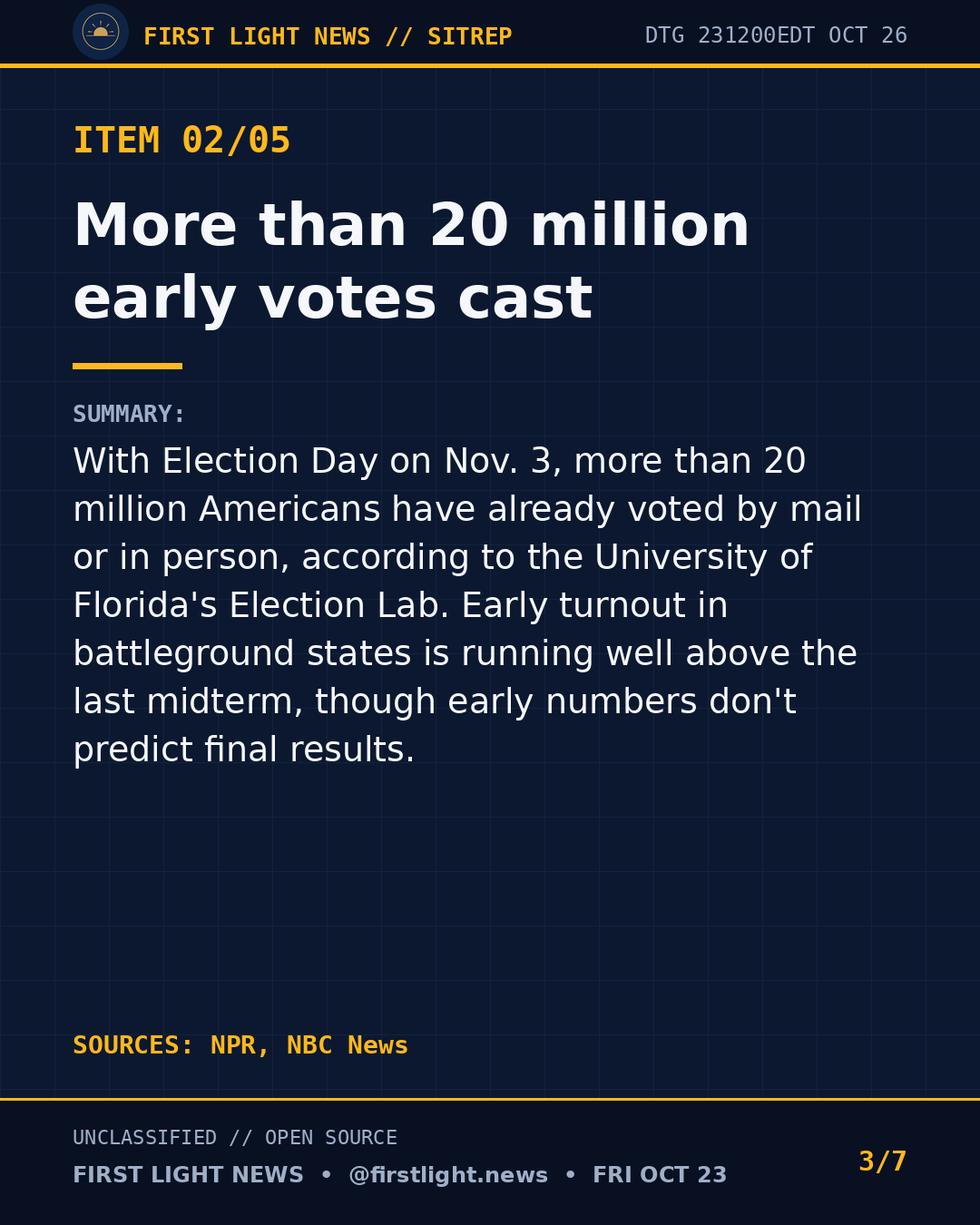
Personalized mRNA cancer vaccine cuts melanoma recurrence in a late-stage trial
Moderna and Merck reported that adding a custom mRNA vaccine (intismeran) to the immunotherapy drug Keytruda after surgery cut the risk of melanoma returning or death by 42% compared with Keytruda alone. The phase 3 trial included 1,137 high-risk patients. Overall survival data aren't mature yet, and the treatment still needs regulatory approval.
AI-driven tech selloff hits Wall Street as oil prices rise
On Thursday the S&P 500 fell 1.2% to 7,663.43, its worst day since July. The Nasdaq dropped 2.6% to 26,008.86, its worst day since June. The Dow edged up 11.89 points to 52,867.98. Chip stocks led the decline after AI-related earnings, including Meta's, renewed worries about AI spending, and oil hit a five-month high on Middle East tensions.

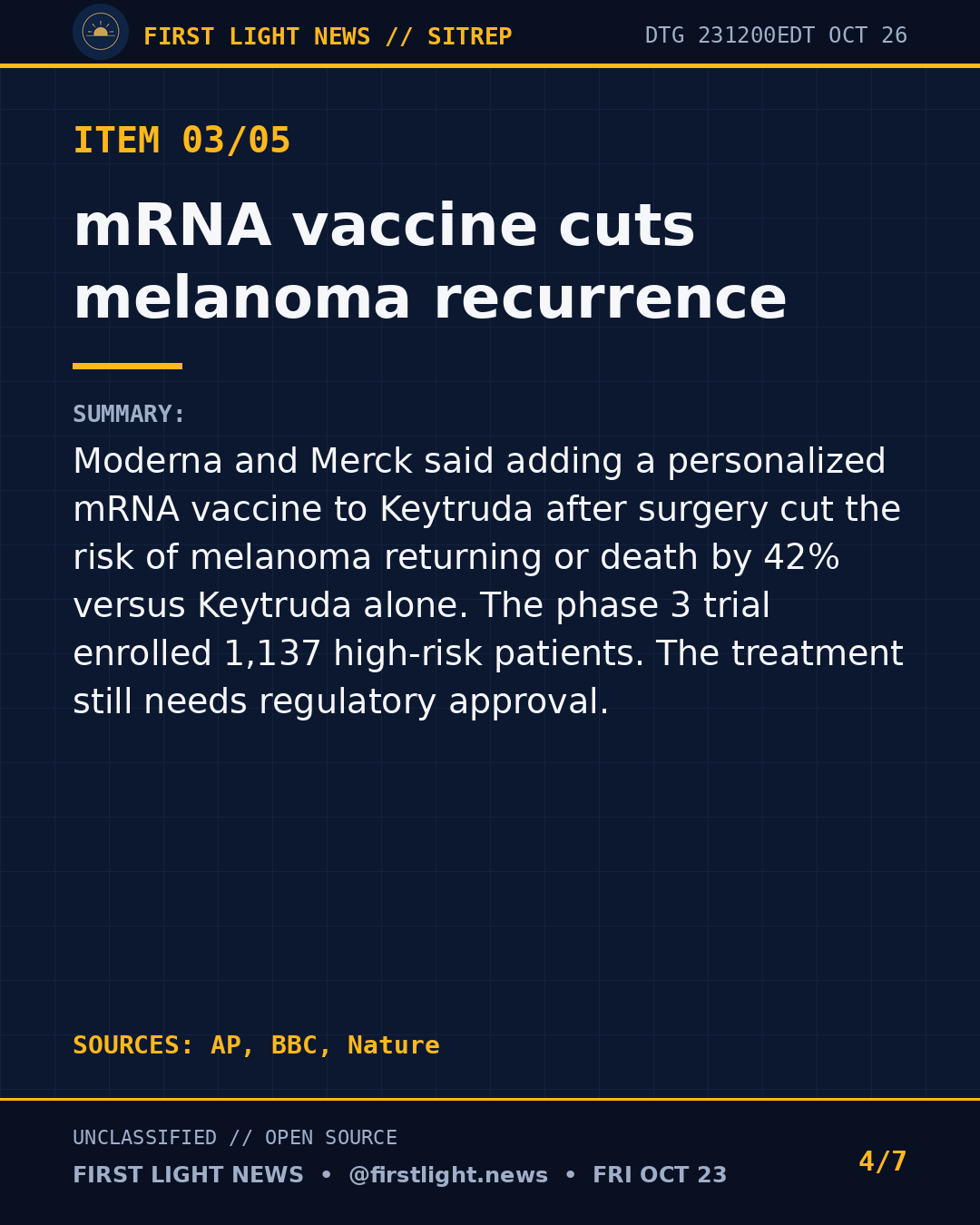
Treasury proposes tighter limits on US tech investments in China and other countries of concern
On Oct 22 the Treasury Department proposed rules to carry out the COINS Act, a 2025 law. The rules would require US investors to notify the government of, or in some cases avoid, certain investments in sectors such as semiconductors, AI, quantum computing and biotechnology tied to China, Russia, Iran, North Korea and Cuba. Publicly traded stocks and many fund investments are exempt, and public comments are due Dec. 7.
Sources
Sourcing note: AP is the only news outlet confirming this. The second confirmation is Treasury's own official release.
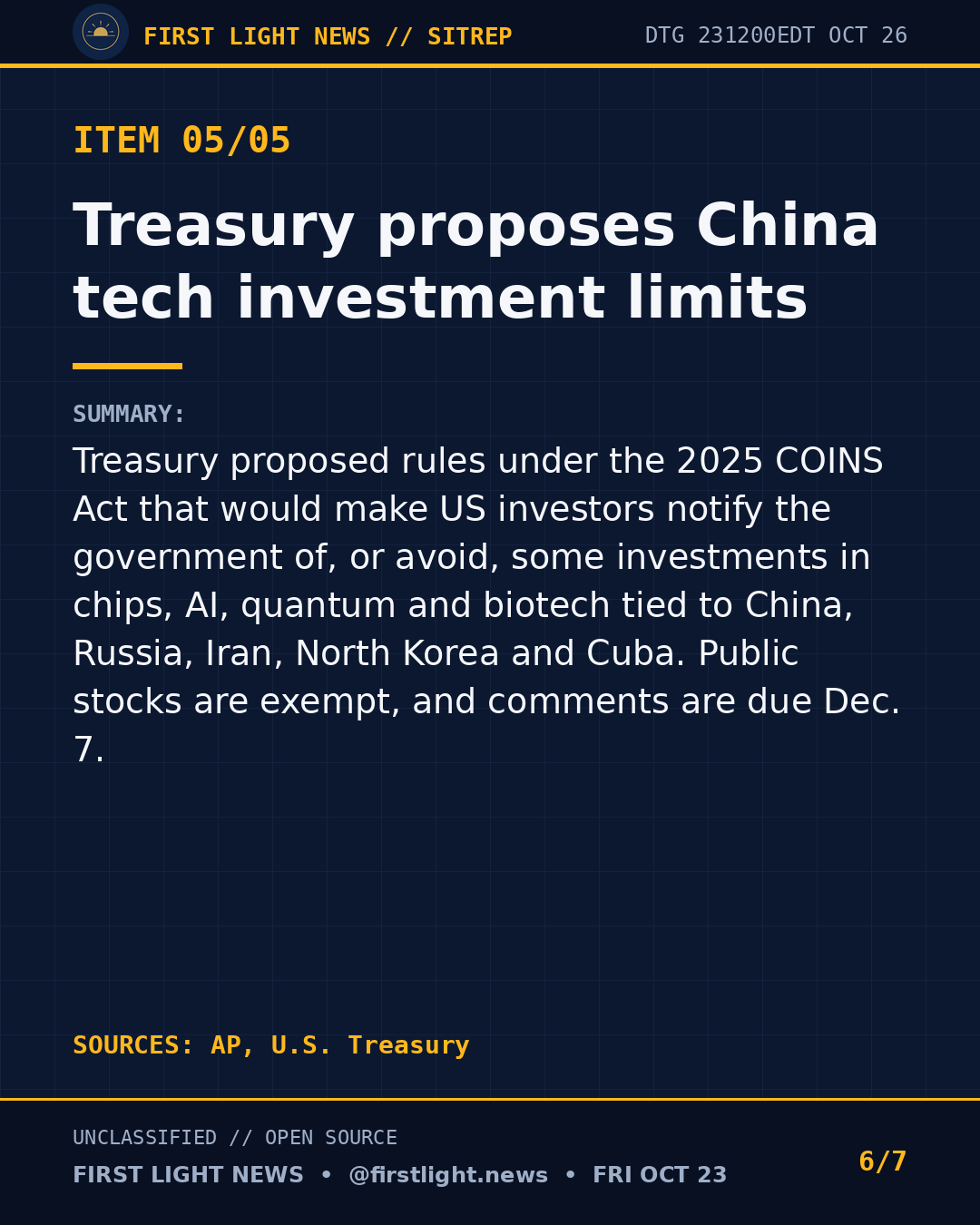
The carousel


As published on Instagram at @firstlight.news.
Sources & methodology
First Light News compiles each brief from published reporting by national news outlets and official primary sources. Every fact is confirmed by at least two outlets before it runs, and each story links the sources it relied on. Where a detail rests on a single outlet or only an official release, we say so in a sourcing note. We do not publish opinion, and we do not use stock or news photography; images on this site are our own carousel slides.